
Understanding the Vesilute Peptide: Mechanism of Action
The vesilute peptide is a short synthetic peptide bioregulator from the Khavinson research tradition, designed to target the tissues of the urinary system and bladder to support overall urinary tract health. This guide explains what Vesilute is, how bioregulators work, Vesilute's mechanism of action, its benefits, dosage and cycling, safety, and where to find Vesilute for sale safely.
Editorial & research disclaimer: This article is for educational purposes only and is not medical advice. Vesilute is a peptide bioregulator and has not been evaluated by the FDA to diagnose, treat, cure, or prevent any disease, including bladder or urinary conditions. Always consult a licensed healthcare professional and verify local regulations before using any peptide.

Quick Answer
What is Vesilute peptide? Vesilute is a synthesized peptide bioregulator (a "cytogen") that targets the urinary system. Chemically it is an L-aspartic acid + L-glutamic acid dipeptide (Asp-Glu or Glu-Asp), also known as alpha-glutamylaspartic acid. In the Khavinson model it acts as an epigenetic signal for cellular communication — entering bladder-tissue cells, reaching the nucleus, and prompting the protein synthesis used for cellular regeneration to repair the detrusor muscle and bladder lining.
As one of the bladder-specific peptide bioregulators, it is sold as oral capsules and used in short cycles (sometimes spelled "vesilut"). Evidence is largely preclinical and from its originating research school, so treat Vesilute as an educational research chemical rather than an approved medicine.
Vesilute is a Khavinson-class bladder bioregulator — an Asp-Glu dipeptide studied for urinary-system support, not an approved drug.
Mechanism is epigenetic by hypothesis: it is proposed to normalize protein synthesis for smooth muscle regulation and smooth muscle function to restore bladder-wall elasticity.
Reported vesilute peptide benefits include overactive-bladder relief, chronic-cystitis support, age-related decline, and prostate synergy — mostly from preclinical and originating-school data.
Vesilute peptide dosage is typically 1-2 capsules daily in 10-30 day cycles, repeated every 4-6 months for maintenance.
Buy on proof. Choose Vesilute from suppliers with COAs and clear Asp-Glu labeling; confirm legality in your region.
What Is the Vesilute Peptide?
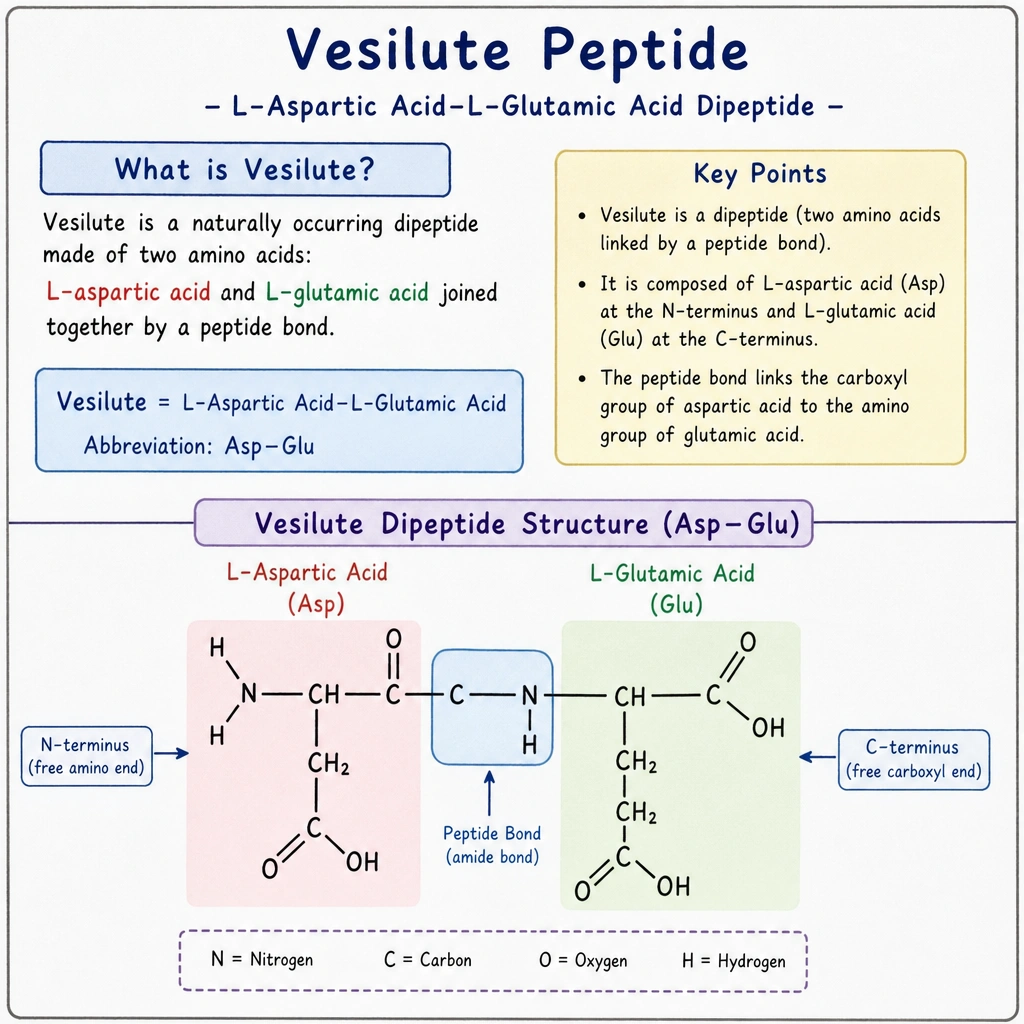
The vesilute peptide (sometimes spelled "vesilut" in international markets) is a highly specific, synthesized bioregulator. Chemically it is an L-aspartic acid and L-glutamic acid dipeptide — exactly two amino acids in a specific amino acid sequence with a molecular formula of C9H14N2O7. L-aspartic acid supports the urea cycle, DNA synthesis, and nerve signaling important for bladder control, while L-glutamic acid is involved in calcium-signaling, cellular metabolism, and muscle-tissue responsiveness. Combined into this dipeptide, they are proposed to act as a "chemical key" that penetrates urinary-tissue cells and interacts with DNA — the essence of how a vesilute peptide bioregulator is thought to operate.
What Are Bioregulators?
Bioregulators (also written "bio regulators") are short peptides — bioregulator peptides — that the body's organs naturally produce to regulate their own gene expression and repair. The peptide bioregulators concept was pioneered by Professor Vladimir Khavinson at the St. Petersburg Institute of Bioregulation and Gerontology. In answer to the common question "what are bioregulators": they are tissue-specific signaling peptides that decline with age, and Khavinson bioregulators aim to replace those missing signals to "reset" a target organ.
Each organ has its own bioregulator, such as Epitalon for the pineal gland. Vesilute serves the bladder; a vascular sibling like Vesugen (the vesugen bioregulator) serves the vascular endothelium of blood vessels to support vascular health; and there are peptides for the heart, brain, thymus, sleep-regulating DSIP, and even a muscle bioregulator. Because these bioregulatory peptides are simply short amino-acid chains with a low molecular weight, they are usually sold as peptide bioregulators supplements in capsule form or as a lyophilized powder for research. For anyone following bioregulator peptide news, Vesilute is a well-established member of this family.
Vesilute's Mechanism of Action
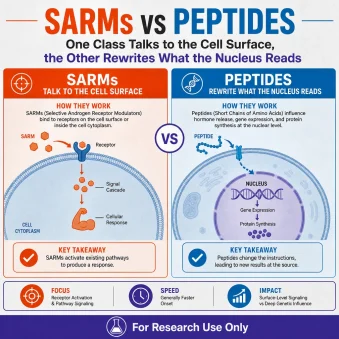
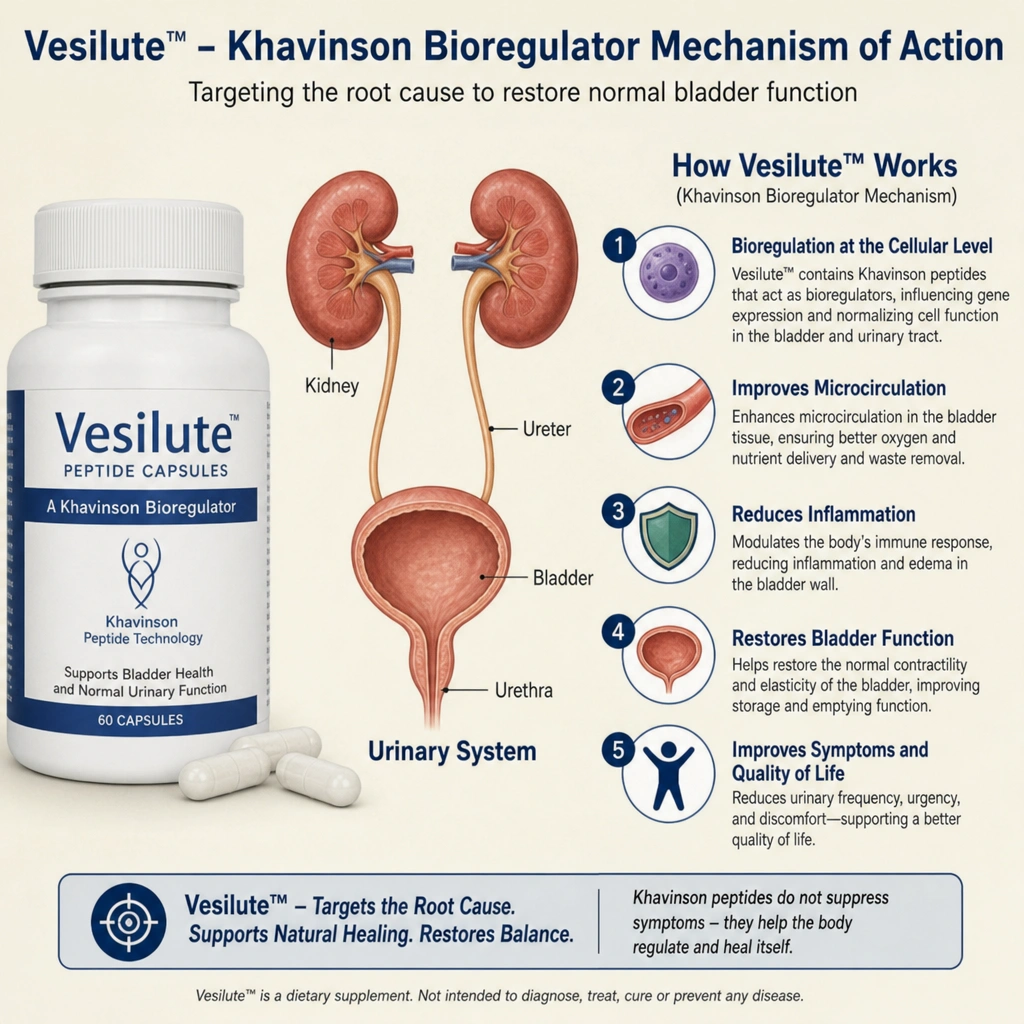
Vesilute's mechanism of action is rooted in epigenetics, the principles of chromatin remodeling, and the stabilization of sister chromatid exchanges. As we age or experience chronic inflammation (such as recurrent UTIs), protein synthesis in bladder cells slows and the DNA becomes tightly wound and less accessible. In the Khavinson model, the vesilute bioregulator is proposed to reverse the effects of cellular aging and restore tissue homeostasis in steps:
- Cellular penetration: the tiny dipeptide bypasses digestive degradation and homes to bladder-wall and sphincter tissue.
- Histone interaction: inside the nucleus it is proposed to help the relevant DNA, nucleolus organizer regions, and heterochromatin structures "unwind" through chromatin decondensation of these chromatin structures so genes become readable.
- Protein synthesis: transcription of ribosomal RNA resumes, supporting healthy cell proliferation and tissue regeneration as the cell manufactures structural proteins.
- Regulating bladder smooth muscle: it is proposed to help the smooth muscle cells of the detrusor contract and relax appropriately, promoting healthy smooth muscle relaxation to reduce spasms and urgency.
- Restoring bladder-wall elasticity: supporting structural proteins so the bladder can fill like a flexible balloon rather than a rigid one.
These are mechanistic, largely preclinical observations, not proven human outcomes.
Vesilute vs. Chitomur: Cytogen vs. Cytomax
Vesilute is a synthetic cytogen; its natural counterpart for the bladder is the cytomax Chitomur, both of which belong to the broader class of cytomedines (sometimes referred to by the Russian term citomedine), similar to the Lys-Glu-Asp-Pro sequence found in other bioregulators. Cytogens act fast; cytomaxes act slower but last longer. A common "stepping-stone" protocol starts with Vesilute to arrest decline, then transitions to Chitomur to lock in results.
| Factor | Vesilute (Cytogen) | Chitomur (Cytomax) |
|---|---|---|
| Type | Synthetic dipeptide (Asp-Glu) | Natural bladder extract |
| Target | Bladder / urinary tissue | Bladder / urinary tissue |
| Onset | Rapid | Slower, gradual |
| Duration | Initiates repair (shorter) | Consolidates (longer) |
| Cost | More cost-effective | More expensive |
| Typical role | Kickstart (10-30 days) | Follow-on maintenance |
Vesilute Peptide Benefits
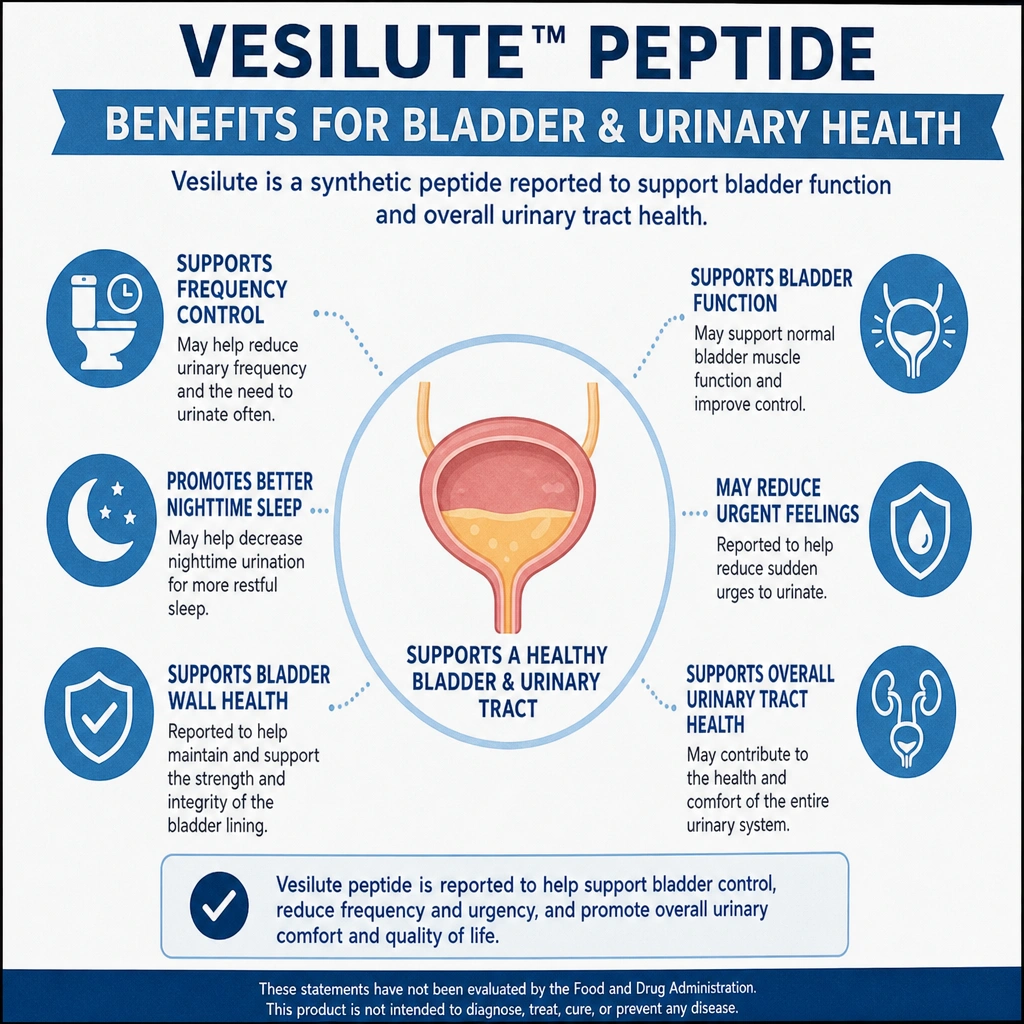
Restoring cellular health to the bladder produces wide-ranging reported vesilute peptide benefits (evidence is largely preclinical and from its originating research school):
- Overactive bladder (OAB) relief: by calming detrusor hyper-reactivity rather than blocking nerves, it is discussed as a natural approach to OAB.
- Chronic cystitis support: not an antibiotic, but proposed to exert anti-inflammatory effects to reduce harmful cellular infiltration, accelerate healing of the bladder lining, and rebuild the protective GAG layer.
- Age-related decline: proposed to restore elasticity and muscle tone, potentially easing nocturia and improving emptying.
- Prostate synergy (men): supports bladder integrity under the mechanical stress of the prostate gland during prostate enlargement or benign prostatic hyperplasia (BPH) or general prostate enlargement; often combined with Libidon, the cytogen Prostamax, Testoluten, or the synthetic cytogen prostamax to support sperm quality and reproductive health.
Do Bioregulators Work for Incontinence?
The answer is nuanced. For urge incontinence (detrusor instability), Vesilute is described as most helpful because it regulates bladder smooth muscle. For overflow incontinence, better contractile strength may aid fuller emptying. For stress incontinence (weak pelvic floor), Vesilute supports bladder tissue but should be paired with pelvic-floor physical therapy (Kegels). It is not a magic bullet, but it may provide the cellular foundation for regaining continence alongside physical therapy.
Vesilute Peptide Dosage and Administration
Because Vesilute is not an approved medicine, there is no official human dose. The vesilute peptide dosage guidance below comes from bioregulator literature and should be treated as research parameters only.
- Therapeutic cycle — 2 capsules per day for 10-30 days (a 30-day cycle is considered the "gold standard").
- Timing — taken together in the morning, 15-30 minutes before a meal, on a relatively empty stomach.
- Maintenance — 1-2 capsules daily for 10 days per month, or a 20-day cycle every 4-6 months.
- Stacking for urogenital aging — Vesilute + Vladonix (immune) + Cerluten (brain-bladder signaling).
- Stacking for chronic cystitis — Vesilute + Vladonix (immune) + Ventfort (to address microcirculation and hyperemia) or systemic repair peptides like BPC-157, CJC-1295, or Tesamorelin.
How to Improve Urinary Function Naturally
Support the peptide's work with holistic habits — how to improve urinary tract function naturally:
- Hydrate, but time it — plenty of filtered water by day; taper fluids 2-3 hours before bed to reduce nocturia.
- Eliminate bladder irritants — caffeine, alcohol, artificial sweeteners, spicy foods, citrus, and tomato products.
- Add bioactive compounds — D-mannose (UTI prevention), pumpkin-seed extract, quercetin, and omega-3s.
- Strengthen the pelvic floor — correctly performed Kegels or pelvic-floor physical therapy.
Safety and Side Effects
Because Vesilute is simply an L-aspartic acid and L-glutamic acid dipeptide — amino acids the body processes daily — its originating research tradition reports an exceptionally high safety profile: no documented toxicity, no allergic reactions (the dipeptide is too small to trigger a histamine response), and no dependency. The only occasionally reported vesilute side effects include mild gastrointestinal upset when taken on a completely empty stomach by sensitive individuals. Independent, large-scale human trials remain limited, so treat these reports as encouraging rather than definitive.
Precautions: consult a healthcare professional first if you have an existing medical condition or take prescription medications.
Where to Find Vesilute for Sale Safely
Growing awareness has brought counterfeit and low-quality products. When searching for vesilute peptide for sale (or "vesilut for sale," depending on regional spelling), exercise due diligence and buy on documentation.
| Factor | High-Quality (Verified) | Low-Quality / Risky |
|---|---|---|
| Source | Traceable to Khavinson technology / authorized distributor | Unknown origin |
| Testing / COA | Certificate of Analysis provided, including HPLC purity testing | Missing or generic |
| Labeling | States Asp-Glu dipeptide composition | Vague ingredient list |
| Form | Capsules (protect the peptide) | Questionable "liquid drops" |
| Price | Reflects real synthesis cost | Suspiciously cheap (filler risk) |
You can use PrymaLab's bioregulator catalog as a reference point for the transparency standards a trustworthy supplier should meet.
Related searches: bioregulator, bioregulator peptide, bioregulators peptides, peptides bioregulators, peptide bioregulators supplements, khavinson peptide bioregulators, bioregulator peptide news, muscle bioregulator, vesugen bioregulator, vesilut peptide, vesilute peptide bioregulator, vesilute peptide vesilute, and what is vesilute peptide.
Researching bladder & urinary bioregulators? Start with verified material.
PrymaLab focuses on US-handled research peptides and supplies like bacteriostatic water with transparent documentation and careful handling.
Explore PrymaLab BioregulatorsFrequently Asked Questions
What is the Vesilute peptide?
Vesilute is a synthesized peptide bioregulator (a cytogen) made of an L-aspartic acid + L-glutamic acid dipeptide that targets the urinary system. In the Khavinson model it enters bladder-tissue cells and interacts with DNA to restore protein synthesis, helping regulate the detrusor muscle and bladder-wall elasticity. It is used as an educational, research-grade compound rather than an approved medicine.
What are bioregulators?
Bioregulators are short peptides that organs naturally produce to regulate their own gene expression and repair. Pioneered by Professor Vladimir Khavinson, these peptide bioregulators are tissue-specific and decline with age. Khavinson bioregulators aim to replace the missing signals to 'reset' a target organ; Vesilute is the bladder-specific member of this family.
What are the main Vesilute peptide benefits?
Reported vesilute peptide benefits include overactive-bladder relief by calming the detrusor muscle, chronic-cystitis support by helping rebuild the bladder lining, easing of age-related decline and nocturia, and prostate synergy in men focused on prostate health with BPH. Evidence is largely preclinical and from its originating research school, so strong disease claims should be treated cautiously.
How does Vesilute work at the DNA level?
Vesilute is a tiny dipeptide that reaches bladder-target tissue, enters the cell nucleus, and is proposed to interact with histones so DNA linked to urinary repair unwinds and becomes readable. This restores RNA transcription and protein synthesis, which normalizes detrusor smooth-muscle activity and helps rebuild structural proteins that restore bladder-wall elasticity.
What is the recommended Vesilute peptide dosage?
A common therapeutic cycle is 2 capsules in the morning, 15-30 minutes before a meal, for 10-30 days (30 days is considered the gold standard). Maintenance is 1-2 capsules daily for 10 days per month, or a 20-day cycle every 4-6 months. These are research parameters, not medical directions, so consult a clinician first.
Is Vesilute safe, and are there side effects?
Because Vesilute is simply an amino-acid dipeptide, its originating research tradition reports no toxicity, no allergic reactions, and no dependency, with only rare mild GI upset on an empty stomach. Independent human trial data are limited. Consult a healthcare professional first if you have a medical condition or take prescription medications.
Where can I find Vesilute for sale safely?
Look for vesilute peptide for sale from sources traceable to Khavinson technology or authorized distributors that provide a Certificate of Analysis and clearly label the Asp-Glu dipeptide composition. Prefer capsules, avoid suspiciously cheap products, and confirm the legal status of the compound in your region before buying.
References & Further Reading
- Khavinson, V.Kh. (2002). Peptides and Ageing. Neuroendocrinology Letters, 23(Suppl 3), 11–144.
- Khavinson, V.Kh., & Malinin, V.V. (2005). Gerontological Aspects of Genome Peptide Regulation. Karger, Basel.
- Anisimov, V.N., & Khavinson, V.Kh. (2010). Peptide bioregulation of aging: results and prospects. Biogerontology, 11(2), 139–149.
- Review literature on short peptide bioregulators and bladder/detrusor tissue (Asp-Glu dipeptide class).
- U.S. Food and Drug Administration. Dietary Supplements: Questions and Answers. FDA.gov. Accessed 2026.
PrymaLab resources: Bioregulator peptides · Research Hub · Peptide calculator · FAQ.
Final disclaimer: This article is for educational purposes only. Vesilute and the other compounds discussed have not been evaluated by the FDA or comparable agencies to diagnose, treat, cure, or prevent any disease, and statements about their effects have not been evaluated by the FDA.
Always consult a licensed healthcare professional before starting any new health protocol, and verify the legal status of any compound in your jurisdiction. PrymaLab does not endorse any specific third-party peptide vendor mentioned in this article and assumes no responsibility for third-party products.